Overview
The Internet of Things (IoT) represents the network of physical devices embedded with sensors, software, and connectivity that enables them to collect and exchange data. From smart home thermostats to industrial sensors monitoring oil pipelines, IoT devices are reshaping how we interact with technology and transforming entire industries.
Key Statistics:
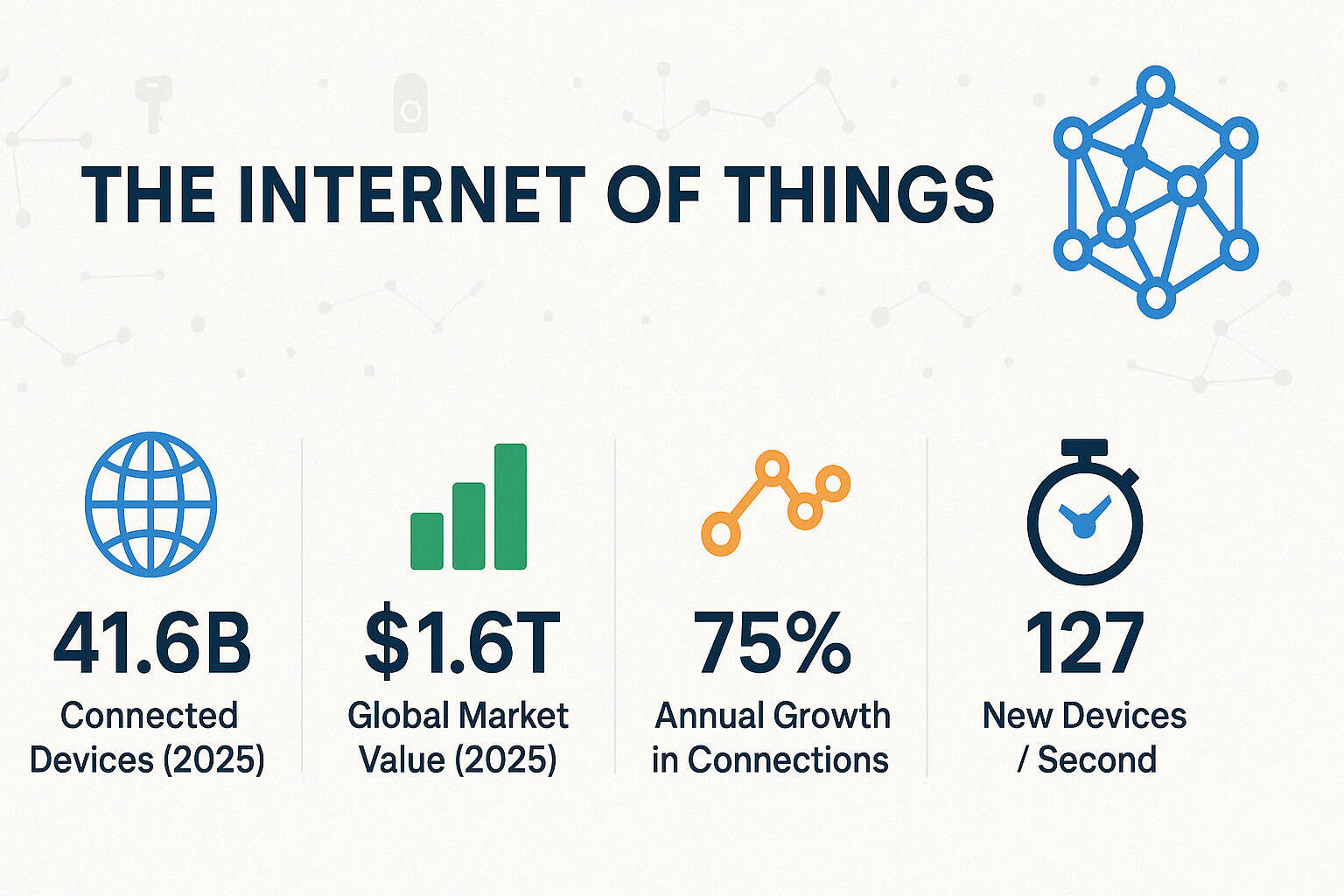
- 41.6 billion connected IoT devices worldwide as of 2025
- $1.6 trillion projected global IoT market value by 2025
- 75% growth in IoT device connections annually
- 127 new devices connect to the internet every second
IoT Connectivity Technologies Explained
Different applications require vastly different performance characteristics. The explosion of IoT has driven innovation in wireless technologies, creating specialized protocols optimized for specific use cases ranging from ultra-low power sensors that operate for years on a single battery to high-bandwidth applications requiring real-time responsiveness.
Low-Power Wide-Area Networks (LPWAN)
New technologies have emerged as paradigm-shifters for IoT applications that need to transmit small amounts of data over long distances while preserving battery life. These networks fill a critical gap between short-range technologies like Wi-Fi and high-power cellular networks.
LoRaWAN (Long Range Wide Area Network) has become the leading standard for applications requiring long battery life and wide coverage areas. Its unique chirp spread spectrum modulation allows signals to penetrate buildings and travel remarkable distances while consuming minimal power.
- Range: Up to 15 km in rural areas, 2-5 km in urban
- Battery Life: 10+ years on a single battery
- Use Cases: Smart agriculture, environmental monitoring, asset tracking
- Data Rates: 0.3 to 50 kbps
NB-IoT (Narrowband IoT) technologies developed by the cellular industry leverage existing cellular infrastructure while providing IoT-optimized performance. This novel approach offers the reliability and coverage of cellular networks with the efficiency needed for IoT applications.
- Range: Up to 35 km in rural areas
- Battery Life: 10+ years
- Use Cases: Smart meters, parking sensors, waste management
- Advantage: Uses existing cellular infrastructure
5G and IoT
5G networks represent a paradigm shift for IoT applications, enabling entirely new categories of connected devices and use cases that were previously impossible due to technical limitations. The ultra-low latency and massive device capacity of 5G networks are particularly transformative for industrial and autonomous vehicle applications.
5G networks are revolutionizing IoT capabilities through four key innovations:
- Ultra-Low Latency: Sub-millisecond response times enabling real-time applications like autonomous vehicles and industrial automation
- Massive Device Connectivity: Up to 1 million devices per square kilometer, supporting dense IoT deployments in urban environments
- Network Slicing: Dedicated virtual networks for specific IoT applications, ensuring guaranteed performance and security isolation
- Edge Computing: Processing data closer to devices for faster response times and reduced bandwidth consumption

Understanding IoT: Core Components
The Internet of Things ecosystem consists of four fundamental layers that work together to create intelligent, connected systems. Understanding these components is essential for grasping how IoT transforms traditional devices into smart, data-driven tools.
1. Connected Devices
Physical objects equipped with sensors, actuators, and communication capabilities. These range from simple temperature sensors to complex autonomous vehicles. Modern IoT devices are becoming increasingly sophisticated, with many incorporating artificial intelligence and machine learning capabilities directly at the device level.
2. Connectivity Networks
The communication infrastructure that links devices to each other and to central systems represents the nervous system of IoT. The choice of connectivity technology often determines an IoT deployment’s success, with each protocol optimized for specific use cases:
- Cellular (4G/5G): Long-range, high-bandwidth connections
- Wi-Fi: Local area networking for consumer devices
- Bluetooth Low Energy (BLE): Short-range, low-power connections
- LoRaWAN: Long-range, low-power wide-area networks
- Zigbee/Z-Wave: Mesh networking for smart homes
- Satellite: Global coverage for remote deployments
3. Data Processing & Analytics
Cloud and edge computing systems that process the massive volumes of data generated by IoT devices, turning raw sensor readings into actionable insights. This layer is where the true value of IoT emerges, as sophisticated algorithms identify patterns, predict failures, and automate responses that would be impossible for human operators to manage manually.
4. User Interfaces
Applications, dashboards, and control systems that allow humans to interact with and manage IoT networks. These interfaces are evolving beyond traditional screens to include voice commands, augmented reality displays, and even direct neural interfaces in experimental applications.

Major IoT Applications by Sector
The Internet of Things is reshaping industries across the global economy, with each sector adapting IoT technologies to solve unique challenges and unlock new opportunities. The following sectors represent the largest and most mature IoT implementations, demonstrating proven return on investment and widespread adoption.
Smart Cities & Infrastructure
Market Size: $2.5 trillion by 2025
Municipal governments worldwide are embracing IoT to create more efficient, sustainable, and livable urban environments. Smart city initiatives typically begin with pilot programs in specific neighborhoods before scaling city-wide, with successful implementations showing measurable improvements in citizen satisfaction and operational efficiency.
- Traffic Management: Real-time traffic flow optimization, reducing congestion by up to 30%
- Waste Management: Smart bins that optimize collection routes, cutting costs by 40%
- Energy Grids: Smart meters and grid management reducing energy waste by 20%
- Public Safety: Connected streetlights, emergency response systems, and environmental monitoring
Key Players: Cisco, IBM, Microsoft, Siemens
Industrial IoT (IIoT)
Market Size: $1.1 trillion by 2025
Manufacturing and industrial operations represent the most mature and financially successful IoT implementations. Industrial IoT focuses on operational efficiency, safety improvements, and cost reduction, with many companies reporting return on investment within 12-18 months of deployment.
- Predictive Maintenance: Sensors that predict equipment failures before they occur, reducing downtime by 50%
- Supply Chain Optimization: Real-time tracking of goods from factory to consumer
- Quality Control: Automated inspection systems using computer vision and sensors
- Asset Tracking: Location and condition monitoring of valuable equipment and inventory
Key Players: General Electric, Honeywell, Schneider Electric, Rockwell Automation
Healthcare IoT
Market Size: $659 billion by 2025
Healthcare IoT is revolutionizing patient care by enabling continuous monitoring, improving treatment outcomes, and reducing healthcare costs. The COVID-19 pandemic accelerated adoption of remote monitoring technologies, with telehealth visits increasing 3,800% during peak pandemic periods.
- Remote Patient Monitoring: Devices that track vital signs and chronic conditions from home
- Medical Asset Tracking: Real-time location of equipment and supplies in hospitals
- Drug Authentication: Anti-counterfeiting systems using blockchain and IoT
- Telemedicine: Connected diagnostic devices enabling remote consultations
Key Players: Philips Healthcare, Medtronic, Johnson & Johnson, Cerner
Consumer IoT
Market Size: $142 billion by 2025
Consumer IoT has achieved mainstream adoption, with the average American household now containing 25 connected devices. This sector drives innovation in user experience and privacy protection, as consumers become increasingly aware of data collection practices and demand greater control over their personal information.
- Smart Homes: Connected appliances, security systems, and energy management
- Wearable Technology: Fitness trackers, smartwatches, and health monitors
- Connected Vehicles: Cars with internet connectivity and autonomous features
- Smart Retail: Cashier-less stores and personalized shopping experiences
Key Players: Amazon, Google, Apple, Samsung
Security and Privacy Challenges
IoT security represents one of the most pressing challenges in technology today, as billions of connected devices create an unprecedented attack surface for cybercriminals.
Unlike traditional computing devices, IoT devices are often deployed in unsecured environments, lack sophisticated security features, and rarely receive security updates throughout their operational lifetime. This combination creates systemic vulnerabilities that affect not just individual users but entire networks and critical infrastructure.
Major Security Vulnerabilities
The distributed nature of IoT deployments makes security particularly challenging, as a single compromised device can potentially provide access to entire networks. Security researchers have identified several categories of vulnerabilities that affect IoT devices across all sectors and price ranges.
Device manufacturers often prioritize cost reduction and time-to-market over security considerations, resulting in fundamental security flaws that persist throughout the device lifecycle. These vulnerabilities are particularly concerning because they often cannot be remediated after deployment.
- Weak Authentication: Default passwords and poor credential management remain the most common attack vector
- Insufficient Encryption: Data transmitted in plaintext or with weak encryption protocols
- Lack of Updates: Devices that can’t be patched for security vulnerabilities discovered after deployment
The wireless nature of most IoT communications creates additional attack vectors that don’t exist with traditional wired networks. Attackers can intercept communications, inject malicious data, or use compromised devices to attack other network resources.
- Man-in-the-Middle Attacks: Interception of device communications through wireless network vulnerabilities
- DDoS Attacks: Compromised devices used to overwhelm networks and online services
- Data Breaches: Unauthorized access to sensitive information collected by IoT devices
Notable IoT Security Incidents
Real-world security incidents demonstrate the potential impact of IoT vulnerabilities, from individual privacy violations to large-scale infrastructure attacks that affect millions of users.
Mirai Botnet (2016): The Mirai attack demonstrated how IoT devices could be weaponized on a massive scale, creating one of the largest botnets in history. This incident fundamentally changed how the security community views IoT threats and led to new legislation requiring better device security.
- Infected 600,000 IoT devices including cameras, routers, and DVRs
- Used for massive DDoS attacks that disrupted major internet services
- Highlighted the danger of default passwords and poor device management
Ring Camera Hacks (2019-2020): Home security camera breaches revealed how IoT privacy violations could enable harassment and stalking, leading to congressional hearings and new industry security standards.
- Unauthorized access to home security cameras through credential stuffing attacks
- Privacy violations and harassment incidents affecting families with children
- Led to improved two-factor authentication requirements and user education programs
Privacy Concerns
IoT devices collect more personal data than any previous technology, often without users fully understanding the scope and implications of this data collection. The intimate nature of IoT data—including location tracking, behavioral patterns, and biometric information—creates unprecedented privacy risks that existing legal frameworks struggle to address.
Data Collection Scope: Modern IoT devices are capable of collecting far more data than their primary function requires, creating detailed profiles of user behavior that extend far beyond the device’s intended purpose.
- IoT devices collect unprecedented amounts of personal data including location, behavior, and biometric information
- Smart home devices can infer daily routines, occupancy patterns, and even health conditions
- Often unclear what data is collected, how long it’s stored, and how it’s used for secondary purposes
Third-Party Sharing: The IoT ecosystem involves multiple parties—device manufacturers, cloud service providers, mobile app developers, and data analytics companies—each with different data handling practices and privacy policies.
- Data frequently shared with advertisers, data brokers, and other third-party companies
- Limited user control over data distribution once collected
- Cross-device tracking creating detailed user profiles that combine data from multiple IoT sources
Investment Trends
IoT represents one of the largest technology investment opportunities in history, attracting funding from venture capital, corporate R&D, and government sources. The scale of investment reflects the transformative potential of IoT across multiple industries and the long-term growth projections for connected device markets.
Venture Capital Investment: $7.2 billion in IoT startups in 2024, with funding concentrated in industrial applications and cybersecurity solutions
Corporate R&D Spending: $180 billion globally on IoT development, led by technology giants like Amazon, Microsoft, and Google, but increasingly including traditional manufacturers and service companies
Government Investment: $45 billion in smart city initiatives worldwide, as municipalities recognize IoT as essential infrastructure for 21st-century urban management
Environmental Impact
The environmental implications of IoT deployment present a complex picture of both opportunities for sustainability improvements and concerns about resource consumption. While IoT technologies enable unprecedented energy efficiency and environmental monitoring capabilities, the manufacturing and operation of billions of connected devices raises questions about the net environmental impact of the IoT revolution.
Positive Impacts
IoT technologies are proving instrumental in addressing climate change and environmental challenges through improved efficiency, better resource management, and real-time environmental monitoring. Many organizations view IoT deployment as essential for meeting sustainability goals and regulatory requirements.
- Energy Efficiency: Smart building systems reduce energy consumption by 20-30% through automated lighting, heating, and cooling optimization
- Precision Agriculture: IoT sensors optimize water and fertilizer use, reducing agricultural waste and environmental runoff
- Carbon Footprint Monitoring: Real-time tracking enables better environmental management and more accurate sustainability reporting
Negative Impacts
The rapid proliferation of IoT devices also creates environmental challenges that must be balanced against the efficiency gains. The lifecycle environmental cost of IoT devices—from manufacturing through disposal—represents a significant sustainability consideration.
- E-Waste: Billions of IoT devices contribute to the fastest-growing waste stream globally, with many devices having short operational lifespans
- Energy Consumption: Data centers processing IoT data consume significant power, potentially offsetting device-level efficiency gains
- Resource Extraction: Manufacturing IoT devices requires rare earth minerals and other materials with significant environmental extraction costs
Future Trends and Predictions
The Internet of Things continues to evolve rapidly, with emerging technologies promising to unlock new capabilities and applications that seemed impossible just a few years ago. These technological advances are converging to create more intelligent, autonomous, and capable IoT systems that will fundamentally change how we interact with the physical world.
Edge Computing Integration
The shift toward processing data at the network edge represents one of the most significant architectural changes in IoT systems. This transformation addresses the limitations of cloud-centric architectures while enabling new real-time applications that require immediate response.
Edge computing is becoming essential for IoT applications requiring immediate decision-making and reducing the massive bandwidth costs of transmitting all sensor data to distant cloud servers. Industry analysts predict this shift will reshape the entire cloud computing industry.
- Processing data closer to devices reduces latency and bandwidth usage, enabling real-time autonomous systems
- 75% of data will be processed outside traditional data centers by 2025, creating new infrastructure requirements
- Enables real-time decision making for autonomous systems like self-driving cars and industrial robots
AI and Machine Learning
The integration of artificial intelligence directly into IoT devices and networks is creating truly intelligent systems capable of learning, adapting, and making autonomous decisions. This evolution from simple data collection to intelligent action represents the next phase of IoT maturity.
- Predictive Analytics: AI algorithms predict equipment failures and optimize performance based on historical patterns and real-time conditions
- Automated Decision Making: Smart systems respond to conditions without human intervention, enabling lights-out operations in factories and data centers
- Natural Language Processing: Voice-controlled IoT interfaces becoming standard, making technology accessible to non-technical users
Digital Twins
Digital twin technology creates virtual replicas of physical systems that enable sophisticated simulation, optimization, and predictive modeling. This approach is particularly valuable for complex systems like manufacturing plants, buildings, and even entire cities.
The digital twin market represents one of the fastest-growing segments within IoT, with applications expanding from manufacturing to healthcare to urban planning. These virtual models enable “what-if” scenarios and optimization strategies impossible to test in the physical world.
- Virtual replicas of physical systems for simulation and optimization, reducing the cost and risk of physical experimentation
- $73 billion market by 2027, driven by adoption in manufacturing, healthcare, and smart city applications
- Applications in manufacturing, healthcare, and urban planning enabling unprecedented system optimization
Quantum Computing Impact
While still in early stages, quantum computing promises to transform IoT capabilities through both enhanced security and unprecedented computational power for processing massive IoT datasets.
- Quantum encryption for ultra-secure IoT communications, addressing current cybersecurity vulnerabilities
- Quantum sensors for unprecedented measurement precision in scientific and industrial applications
- Quantum algorithms for processing massive IoT datasets, enabling insights impossible with classical computing
Key Industry Players
The IoT ecosystem spans technology giants, specialized IoT companies, and traditional industrial firms adapting to the connected world. Understanding the competitive landscape helps explain market dynamics, partnership strategies, and the direction of technological development. The industry has evolved from early experimentation to mature platforms serving millions of devices and generating billions in revenue.
Technology Giants
The world’s largest technology companies have made massive investments in IoT platforms, viewing connected devices as essential for their cloud computing and artificial intelligence strategies. These companies leverage their existing infrastructure and developer ecosystems to dominate the IoT platform market.
Amazon Web Services (AWS): Amazon has built the world’s largest IoT platform by leveraging its dominant position in cloud computing and extending its reach into consumer devices through the Alexa ecosystem. The company’s strategy combines infrastructure services with consumer hardware to create a comprehensive IoT ecosystem.
- IoT Core platform serving millions of devices across industrial and consumer applications
- Alexa ecosystem dominating consumer IoT with over 100 million devices worldwide
- $15 billion IoT revenue in 2024, making it the largest IoT platform provider globally
Microsoft Azure: Microsoft has focused on enterprise and industrial IoT applications, building comprehensive platforms that integrate with existing business systems. The company’s strength in enterprise software has translated into strong adoption among large corporations implementing IoT solutions.
- Comprehensive IoT platform with AI integration and enterprise-grade security
- Strong enterprise and industrial focus, with particular strength in manufacturing and energy sectors
- 10 billion+ connected devices on platform, primarily in business and industrial applications
Google Cloud: Google has differentiated itself through advanced AI and machine learning capabilities integrated into its IoT offerings. The company’s strength in data analytics and artificial intelligence creates unique value for IoT applications requiring sophisticated data processing.
- Edge computing and AI-powered IoT solutions with industry-leading machine learning capabilities
- Focus on smart cities and retail applications, leveraging Google’s expertise in location services and commerce
- Growing enterprise market share, particularly in data-intensive IoT applications