Best Business Internet Service Providers for 2026: Compare Plans and Costs
AT&T Business Fiber takes the top spot for 2026 with symmetrical multi-gig speeds, followed closely by T-Mobile for Business for rapid 5G deployment and Starlink-backed SuperBroadband redundancy.



- AT&T Business is the best overall choice because it excels at pure performance, combining symmetrical multi-gig fiber network speeds up to 5 Gbps (where download rates are equal to upload capacities) with competitive starting prices, dedicated commercial support, and dependable wireless backup options.
- T-Mobile for Business is the premier wireless solution, offering flexible, no-contract 5G internet plans for small businesses alongside its revolutionary SuperBroadband (5G + Starlink) failover service for enterprise redundancy.
- Comcast Business rounds out our top three as the best cable and bundling option, balancing widespread national availability with scalable plans up to 2 Gbps, multi-service voice and mobile discounts, and optional LTE cellular failover.
Premium business internet is foundational to keeping operations online, whether you orchestrate a large corporate suite that relies heavily on 4K multi-channel Zoom conferences or a local brick-and-mortar storefront dependent on continuous cloud-based point-of-sale systems. Business-grade service differs from residential internet setups by guaranteeing priority for local office network traffic during peak weekday congestion and offering automated failover protection against outages. Strong business-class support also supplies dedicated, immediate-response tech agents structured purely for specialized corporate diagnostic tracking. To help determine which provider aligns best with your professional logistics, we rigorously evaluated the largest commercial ISPs on symmetrical speeds, 5G and satellite redundancy, flexible subscription costs, transparent usage terms, and long-term reliability.
AT&T Business Internet is our top recommendation for most small and midsize businesses thanks to its fast, symmetrical fiber speeds up to 5 Gbps, 99.9% reliability, and straightforward pricing starting at $60 per month. If you don’t have fiber access, or if you need rapid deployment and unbreakable failover, T-Mobile for Business is a standout runner-up for plug-and-play 5G internet and Starlink-backed continuity.
AT&T Business Internet (BroadbandNow Top Pick)
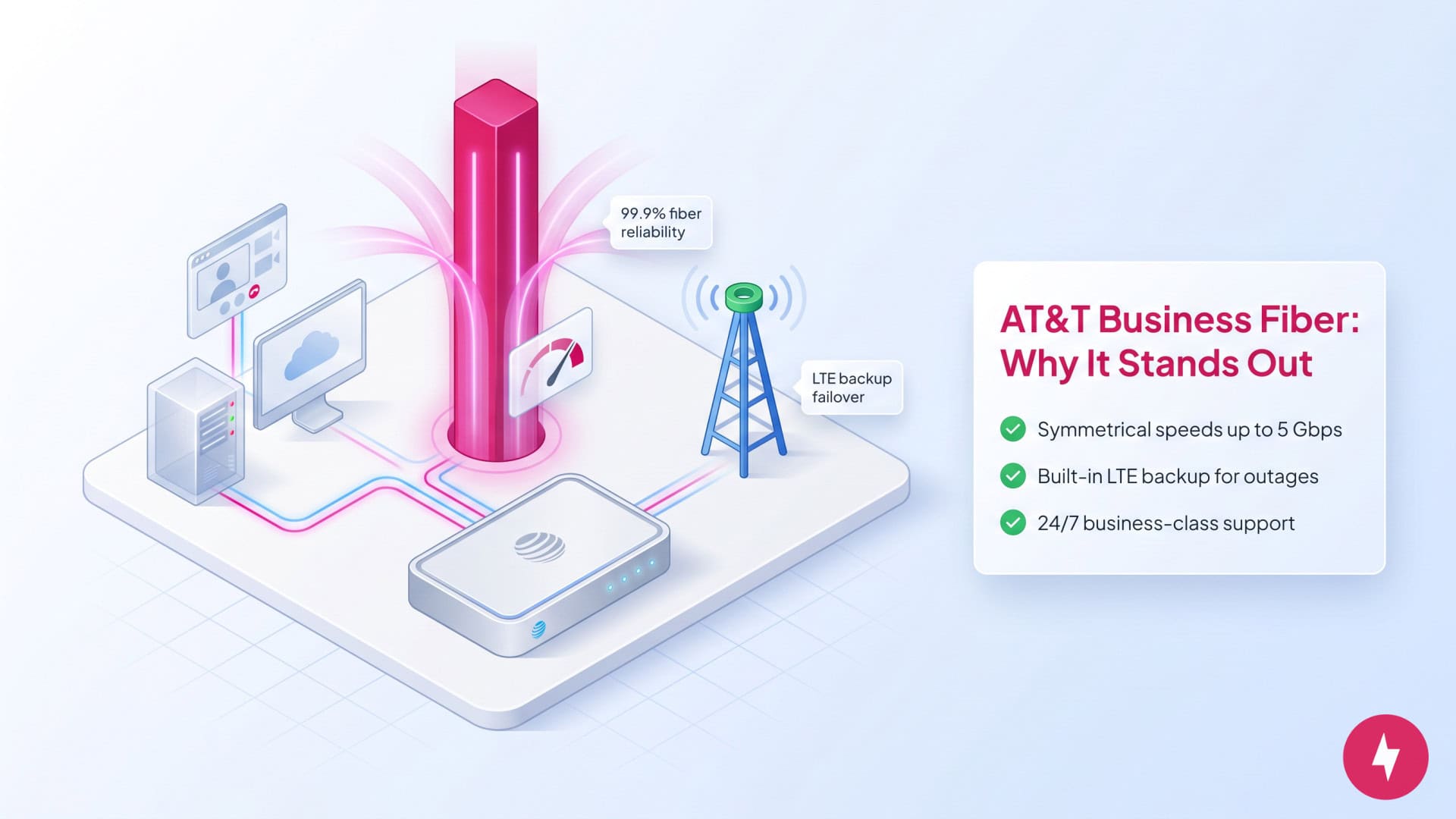
Who it’s best for: Growing offices, cloud-heavy teams, and enterprises that need fast, symmetrical upload and download speeds with rock-solid fiber reliability.
AT&T Business Internet is a leading fiber-optic service provider, selected as our best pick for its massive multi-gigabit speeds and excellent reliability. AT&T Business Fiber offers speeds up to 5 Gbps and is even available to small businesses in residential areas. These plans feature symmetrical speeds, meaning your upload bandwidth is exactly as fast as your download bandwidth. Fiber internet is the best connection for companies that regularly transfer large data files, host secure video conferences, or work in live production.
In addition to providing fast speeds, AT&T offers cellular wireless backup, often referred to as LTE backup, which is a failover connection that automatically keeps your network online if the primary wired connection drops. This ensures critical devices, such as point-of-sale machines and credit card readers, will stay online until your primary fiber service comes back. In the event of service outages or other issues, AT&T’s business-class customer service is available for all support inquiries. Business-class support refers to specialized, priority technical assistance backed by service-level agreements (SLAs) tailored for commercial accounts rather than residential users. Outside of critical outage support, AT&T’s customer service can also help with more minor requests related to your business internet ISP account configuration, such as setting up private Wi-Fi networks.
With multiple contact methods and 24/7 support, business owners can rest easy knowing that AT&T has their back. Whether you’re a large-scale business, a multimedia company, or a growing startup, AT&T Business Fiber Internet plans offer a consistent, fast connection with symmetrical speeds up to 5 Gbps at an affordable price.
What We Like
- Symmetrical fiber speeds up to 5 Gbps with 99.9% network reliability
- Built-in cellular backup systems that prevent long outages
- 24/7 business-class customer service tailored to commercial accounts
What We Don't Like
- Multi-gig fiber availability is limited to AT&T’s 21-state wireline footprint
- Speeds are much slower in areas limited to legacy copper connections
T-Mobile for Business (Best 5G & Backup Internet)
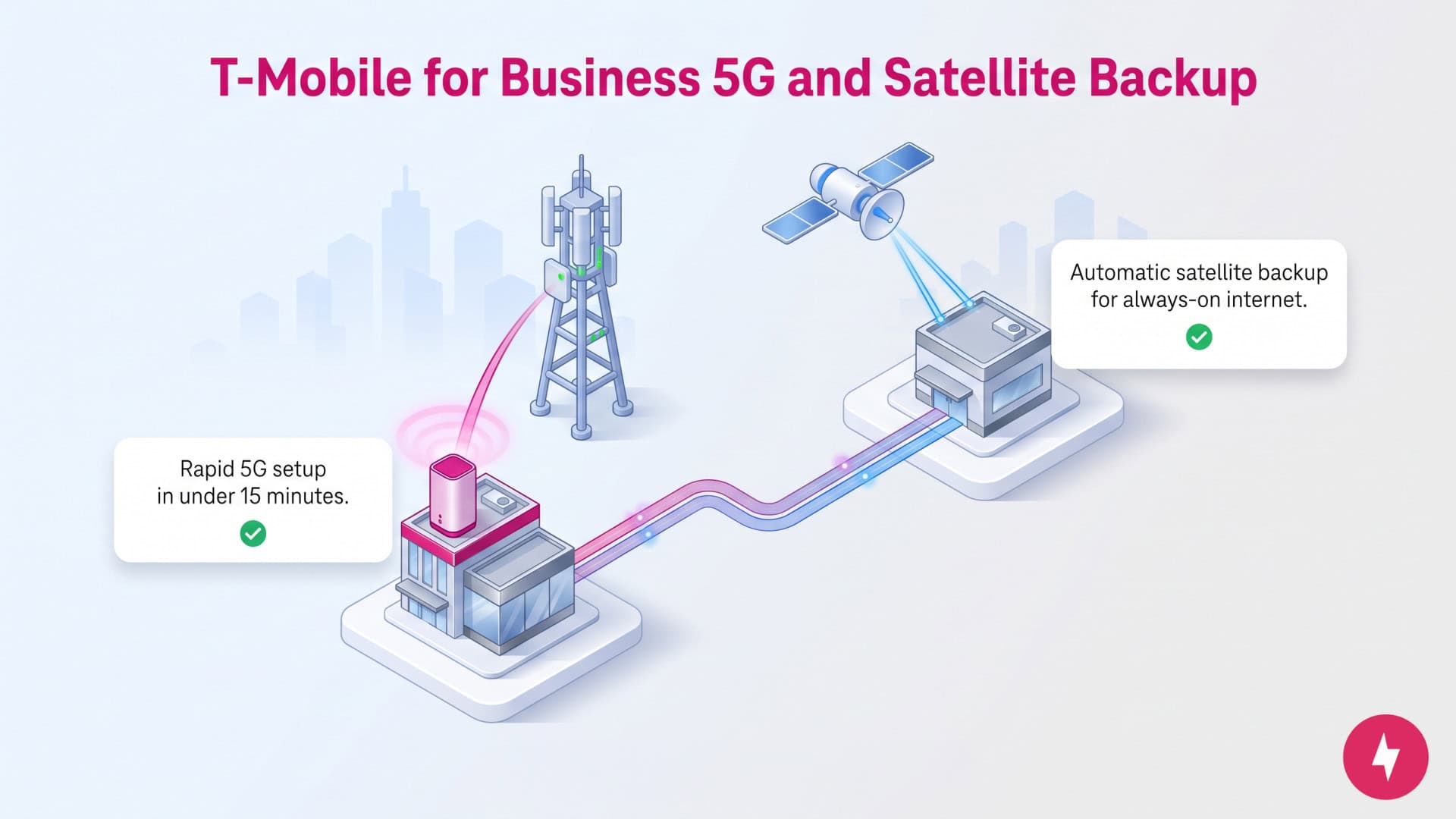
Who it’s best for: Small businesses looking for affordable, no-install 5G for small business, as well as multi-location or remote operations that need always-on backup internet for business.
T-Mobile for Business leads the commercial wireless space by solving two common headaches: slow wireline installations and costly network outages. Because it is delivered wirelessly over 5G, businesses can bypass the hassle of underground cables and weeks of installation wait times, with most businesses up and running in under 15 minutes using self-setup via the Inseego Go app.
T-Mobile’s standard Unlimited Business Internet plan starts at $35 per month when bundled with any business voice line (or $60 per month standalone) and includes a 5-Year Price Guarantee, a free Wi-Fi 7 gateway, built-in enterprise cybersecurity, and up to $800 to cover early termination fees from your old ISP. You can even tap into the Static IP upgrade option if you need a consistent network address for your business. Best of all, these plans operate month-to-month with no annual contracts, so you aren’t locked into the heavy, stipulation-laden contracts most business ISPs require.
For companies that can’t afford a minute of downtime, T-Mobile SuperBroadband (starting at $250 per month with a 36-month commitment) is the first nationwide solution to integrate terrestrial T-Mobile 5G Advanced with Starlink satellites under one contract. Available in every U.S. ZIP code, SuperBroadband uses 5G for primary traffic, balances heavy loads across both networks during peak hours, and automatically fails over to Starlink if local 5G goes down, complete with professional installation and 24/7 monitoring.
What We Like
- Rapid 15-minute self-setup with no construction or technician visits required
- Low starting price of $35 per month with a voice line and no annual contract
- Unmatched redundancy via SuperBroadband, pairing 5G Advanced with automated Starlink satellite backup
What We Don't Like
- Wireless speeds vary depending on local 5G tower proximity and network traffic
- SuperBroadband requires a 36-month commitment and a clear view of the sky for satellite hardware
Comcast Business Internet (Best for Bundles & Availability)
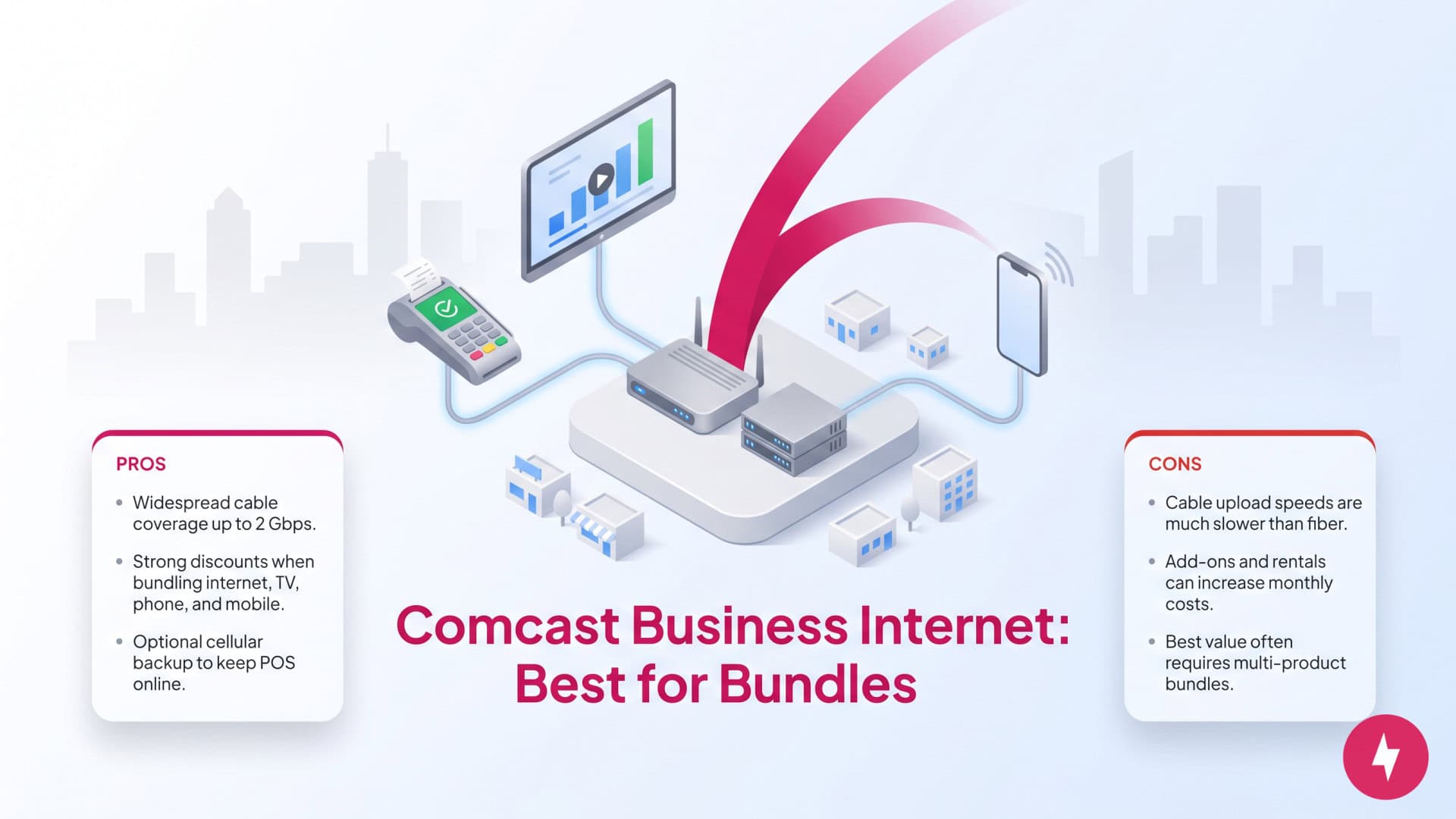
Who it’s best for: Brick-and-mortar shops, restaurants, and offices within Xfinity’s broad cable footprint that want to bundle internet with phone, TV, or mobile service.
Thanks to its massive coast-to-coast cable network and flexible bundling options, Comcast Business Internet remains a dependable workhorse for businesses where fiber isn’t an option. Plans start at $70 per month for 150 Mbps downloads and scale up to 2 Gbps on cable, with dedicated Metro Ethernet fiber available for larger corporate sites.
Comcast stands out when you pair internet with voice lines, lobby TV packages, or Comcast Business Mobile, often unlocking multi-year price locks and prepaid reward cards. You can also add Connection Pro cellular backup and SecurityEdge protection, though add-on fees and equipment leases can push your monthly bill higher than all-in-one fiber or 5G plans.
What We Like
- Widespread availability across 39 states with download speeds up to 2 Gbps
- Strong multi-product discounts when bundling voice, public-view TV, and mobile
- Optional Connection Pro cellular backup available to keep POS systems online
What We Don't Like
- Cable upload speeds (typically 20 to 40 Mbps on lower tiers) are much slower than fiber
- Equipment rentals and failover add-ons cost extra on most plans
Spectrum Business Internet (Budget Pick)
Who it’s best for: Budget-minded small businesses in Spectrum’s footprint that want fast cable download speeds without signing an annual contract.
If your business operates in a Spectrum market and wants wireline speeds without a multi-year commitment, Spectrum Business Internet is a practical, low-stress choice. Even its standalone internet plans include a free modem, free custom installation, and desktop security software at no additional cost.
If your office needs extras like static IP addresses (a fixed internet address used for hosting servers or running VPN security protocols), wireless internet backup, or managed Wi-Fi, Spectrum offers them as straightforward a la carte add-ons alongside voice and mobile bundles.
What We Like
- Contract-free plans with no early termination fees
- Free modem, installation, and security suite included
- Fast cable download speeds scaling up to 1 Gbps
What We Don't Like
- Asymmetrical upload speeds lag behind fiber competitors
- Promotional pricing increases after the initial 12- or 24-month period

gFiber Business (Best for Straightforward Speeds and Pricing)
Who it’s best for: Businesses that want transparent pricing and top-tier speeds without the hassles.
If you want fast, symmetrical speeds and transparent pricing without the hassle of long-term contracts, then gFiber Business is relatively unbeatable. Offering tier plans that scale up to 2 Gbps, its fiber-optic internet allows employees to upload large cloud backups quickly and provide crisp video quality for online meetings. Along with its award-winning customer service, Google Fiber provides businesses on the Business 2 Gig plan with a Wi-Fi 6 router and a free mesh Wi-Fi extender, so everyone in the office can experience seamless, high-quality internet speeds.
All of these premium capabilities come at a cost, literally. Starting at $100 per month for the base 1 Gbps plan, fiber internet is generally more expensive compared to other internet options like traditional cable, so businesses would need to consider their operational budget before investing. Additionally, fiber internet is not available everywhere, so businesses in rural areas or other areas with generally limited internet availability may not be able to use it. That said, if Google Fiber is available in your area and you’re willing to pay for its services, it may be worthwhile, especially if your business plans to scale and requires high network bandwidth.
What We Like
- Reliable and fast symmetrical internet connection
- Focus on complete connectivity for your company with a mesh network
- Award-winning history of customer service satisfaction
What We Don't Like
- High starting prices compared to the competitors
- Limited availability geographically
Our Top Business Internet Recommendations
While we’ve covered several strong commercial internet options above, here is a quick side-by-side comparison of our top three picks:
| Details | BroadbandNow Top Pick | Best 5G & Backup Internet | Best for Bundles |
|---|---|---|---|
| Provider name | AT&T Business Internet | T-Mobile for Business | Comcast Business Internet |
| Connection type | Fiber / Fixed Wireless | 5G Fixed Wireless / Starlink Satellite | Cable / Fiber |
| Max download/upload speeds | Up to 5 Gbps symmetrical | Up to 361 Mbps / 38 Mbps (5G + Starlink load balancing) | Up to 2 Gbps / 40 Mbps |
| Starting price | $60 per month | $35/mo. (with voice line) / $60/mo. standalone ($250/mo. for SuperBroadband) | $70 per month |
| Backup option | AT&T Internet Backup (LTE/5G) | Automated Starlink Satellite Failover (SuperBroadband) or 5G Backup | Connection Pro (4G LTE add-on) |
| Static IP availability | Yes (Added fee) | Yes (Available upgrade) | Yes (Added fee) |
| Support & SLA | 24/7 support (SLA on dedicated fiber) | 24/7 support & monitoring included on SuperBroadband | 24/7 support (SLA on fiber only) |
| Bundle options | Phone, Mobile, Security | Mobile Voice, Tablets, Connected Devices | Phone, TV, Mobile |
| Best-for scenario | Heavy uploaders and cloud-reliant offices | Fast 15-minute setup and always-on multi-site redundancy | Retailers and offices bundling cable, voice, and TV |
| More info | View AT&T Business Internet Deals | View T-Mobile Business Deals | View Comcast Business Internet Deals |
Why People Are Switching to 5G Business Internet
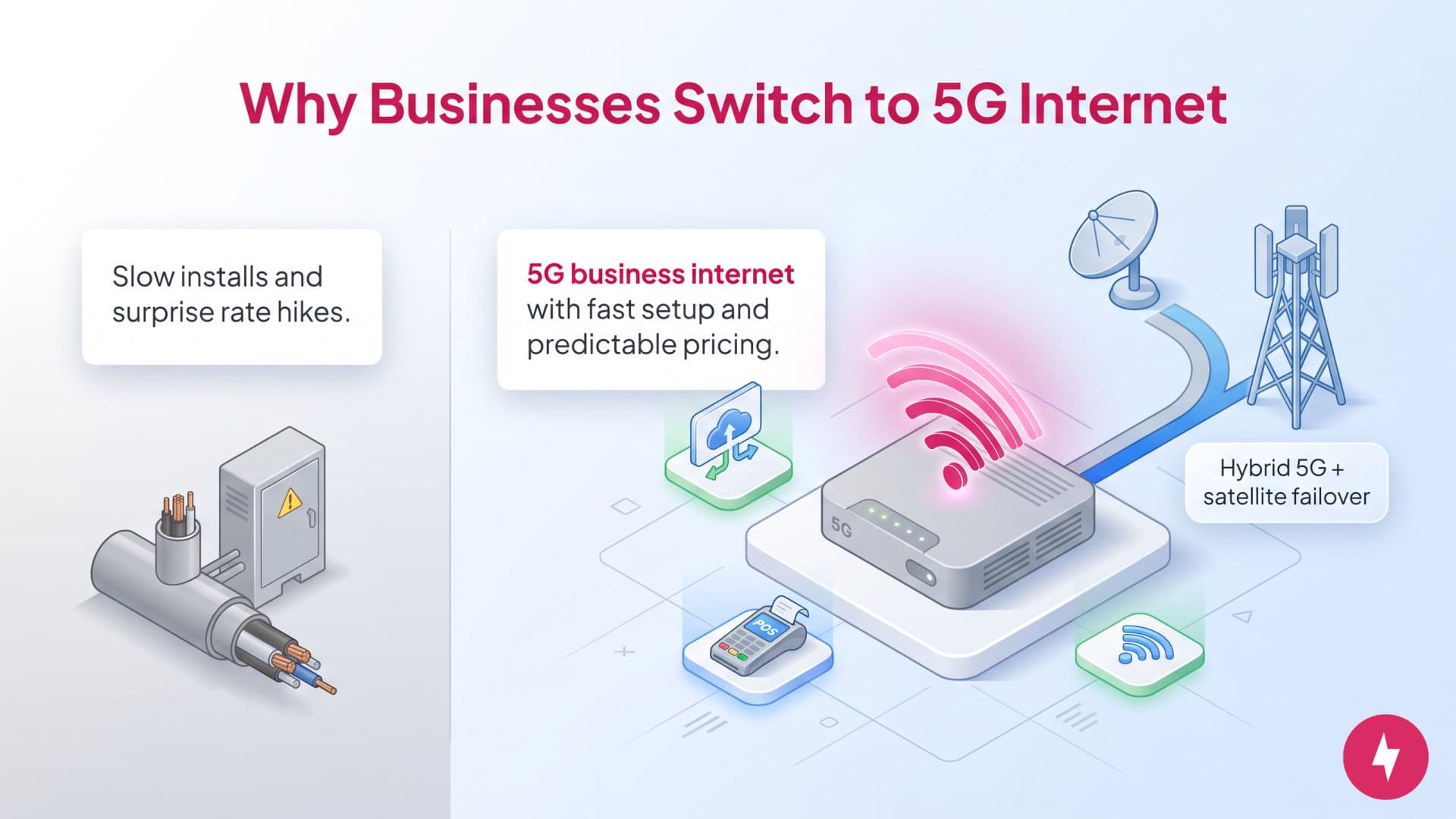
More companies are choosing 5G business internet over traditional cable and copper lines because it removes the two biggest frustrations of commercial telecom: slow installations and surprise rate hikes. Instead of waiting weeks for construction permits or technician appointments, small businesses can ship a pre-configured 5G gateway to a new office or storefront and get online in 15 minutes.
Wireless broadband has also closed the reliability gap for larger organizations. While standalone 5G for small business handles everyday cloud workflows, POS terminals, and guest Wi-Fi at a locked-in rate, hybrid solutions like T-Mobile’s SuperBroadband pair terrestrial 5G with Starlink satellite connectivity. That gives multi-location enterprises, financial branches, and remote job sites primary wireless internet, load balancing, and automatic failover on a single contract without having to manage two separate ISPs.
Why You Should Choose Business Internet
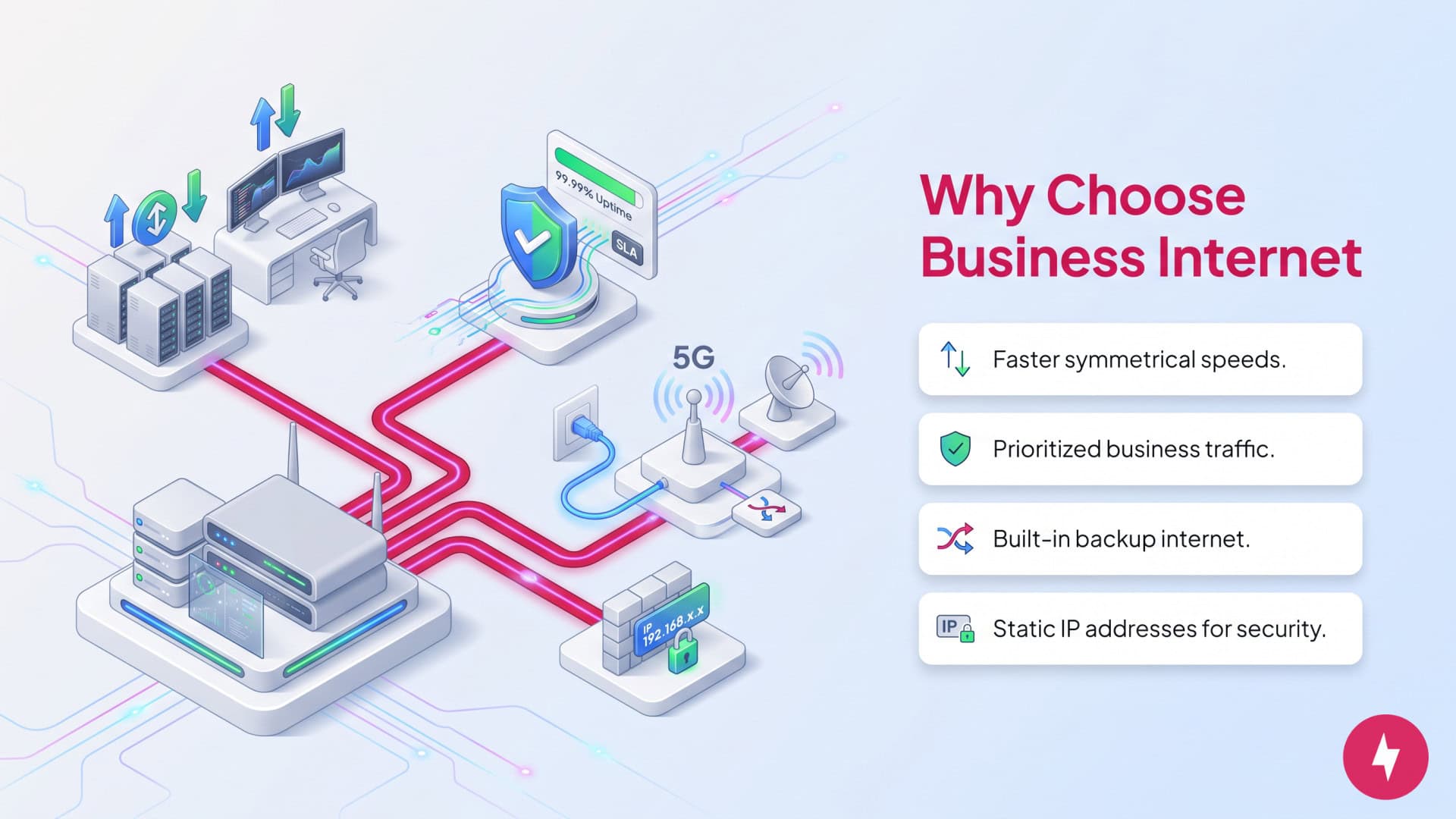
Relying on a residential internet plan to run your workplace can leave you vulnerable to midday slowdowns and costly outages. Upgrading to a dedicated business internet plan gives you four major advantages:
- You need faster speeds than residential internet. Business plans offer higher symmetrical upload capacities (like AT&T’s 5 Gbps fiber tiers) and multi-network load balancing built to support dozens of employees and connected devices at once.
- You want your internet service prioritized. Commercial ISPs prioritize business traffic during peak weekday hours and offer service-level agreements (SLAs) that guarantee uptime and faster repair windows.
- You need backup internet. Even a brief outage can halt credit card processing and cloud tools. Business providers offer automated backup internet for business, ranging from cellular failover add-ons to T-Mobile SuperBroadband’s integrated 5G and Starlink satellite redundancy.
- You require static IP addresses. Unlike residential connections that use dynamic IPs, business plans offer static IP addresses essential for running secure VPNs, remote servers, and point-of-sale networks.
How We Chose Our Favorite Business Internet Providers
To operate a business smoothly, companies require a reliable internet service provider. Without a reliable connection, the business can suffer. We used these key factors to choose our top picks for business ISPs:
- Availability: Having wide availability ensures businesses can find a provider in their area without too much digging. We chose providers that featured the most coverage across the United States.
- Speed: Businesses don’t have time to wait for slow internet. Whether it is ringing up customers on local point-of-sale systems or hosting 4K video calls from a home office, companies rely on fast internet speeds and dedicated internet (a private, secure connection not shared with neighboring users) to get the job done and keep customers satisfied.
- Value: Budgets are often a concern for businesses of all sizes. We researched top ISPs offering quality service at reasonable prices, meaning plans that could work for small and large businesses alike. This includes looking for extras like a static IP, a permanent internet address necessary for hosting servers or accessing secure private networks, included at a strong price point.
- Reliability: Businesses should run like well-oiled machines, and when internet service isn’t keeping up, it can reflect poorly on the company. We chose providers known for offering reliable service, especially to business customers. We highly rank companies offering LTE backup, a failover cellular network connection that kicks in automatically if your primary wired connection drops.
- Reputation: For businesses experiencing internet issues, there’s no time to waste. For our best list, we chose only providers with a reputation for delivering excellent service to their business customers.
How We Assessed Business Internet Providers
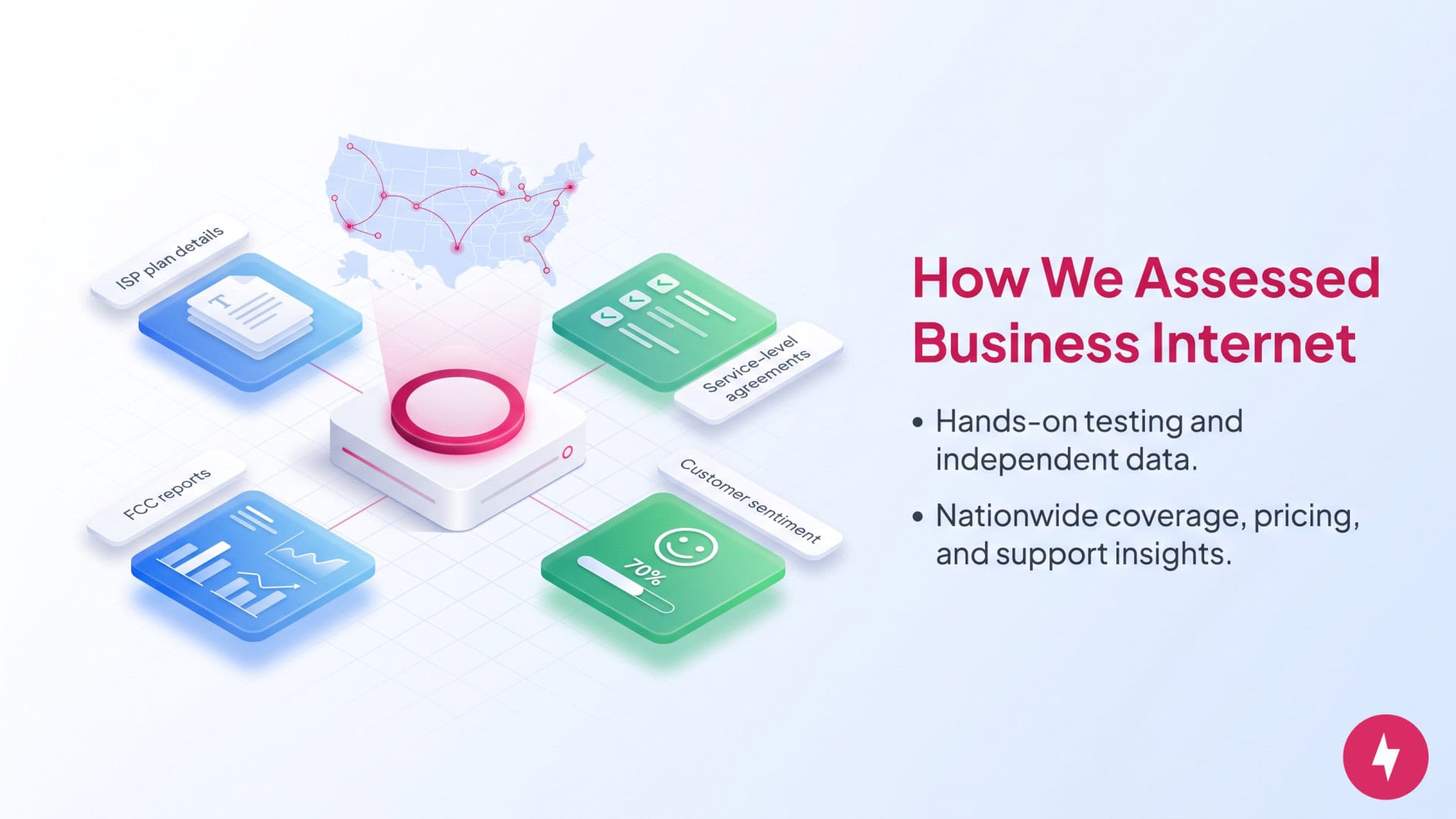
From setting up your internet connection to navigating the complexities of customer support, firsthand encounters offer the most precise insights for business internet customers. We conducted extensive assessments of major U.S. internet service providers (ISPs) and regional fiber networks to deliver impartial evaluations to guide your decision-making, regardless of your location or the availability of business ISPs.
But our research didn’t end there. In addition to our direct experiences, we dove into data from diverse sources to rank these services. We meticulously examined reports and studies from the Federal Communications Commission (FCC), leveraging the FCC’s Broadband Data Collection to gain deeper insights into ISPs. Furthermore, we engaged directly with ISPs to gather up-to-date details on plans, pricing, promotions, and coverage.
Our dedicated team meticulously evaluated aspects such as service-level agreements (SLAs), which are contracts guaranteeing a certain level of network uptime, availability, and pricing adjustments, while BroadbandNow Research scrutinized ISP assertions and forged partnerships with prominent broadband entities like Microsoft and the NTIA to provide insightful perspectives on the broadband landscape. Additionally, we sought input from reputable organizations such as the American Customer Satisfaction Index (ACSI), J.D. Power, and the Better Business Bureau (BBB). This, along with direct user feedback, helped us gauge customer sentiment regarding ISP performance and support options.
Other Business Internet Providers Worth Mentioning
The following ISPs may not offer as many perks as the ones we’ve mentioned above, but they’re great alternatives for business owners outside major coverage areas and can even serve as backup options to keep businesses connected. Finding the right business internet ISP often requires looking at regional operators or specialized wireless carriers to secure a reliable, tailored network solution.
- Quantum Fiber (formerly CenturyLink): Similar to AT&T, Quantum Fiber’s business internet options include a basic internet plan and a business fiber plan. All of Quantum Fiber’s plans come without contracts and with 24/7 customer support. Business owners can make the most of Quantum Fiber’s deals to stay within their budget. This tier of business-class support guarantees priority assistance over residential routing for troubleshooting network issues.
- Viasat: One of the few providers on the market that offer satellite internet for small businesses, Viasat is great for those who live in rural or low-connectivity areas. Viasat offers the same perks as some of the more popular internet providers and provides professional installation. Viasat’s Business Internet services also come with around-the-clock support, 7 days a week.
- Verizon: Best known for its phone services, Verizon offers 5G wireless and business internet plans at affordable prices. Businesses can also bundle business internet with a phone line to save even more. Verizon also provides LTE backup, an automated cellular connection that keeps your network online if the primary wireline network fails.
How to Pick an Internet Provider for Your Business
Every organization operates differently and manages its own unique set of network needs. A local boutique shop might only need a basic connection to run cloud-based point-of-sale (POS) systems, while a large architecture firm requires enough bandwidth to send heavy computer-aided design (CAD) files and conduct ongoing video conferences without lag.
Before signing an agreement, verify whether your provider enforces a data cap, which is a monthly limit on how much data your business can consume before facing overage fees or throttled speeds. You should also confirm if your daily operations require a static IP, a permanent internet address required for hosting private enterprise servers, secure email platforms, or advanced business VPNs. Here are a few essential tips you should consider before committing to a new business internet plan:
Pick Your Speed Based on the Size of Your Business
For a smaller team or location with one to nine employees, a basic business internet plan will usually suffice. However, larger offices that rely on a strong internet connection should consider some of the fiber optic internet plans available on the market. Fiber connections often deliver symmetrical speeds. This balance ensures swift cloud access and lag-free collaboration. Mid-size to enterprise facilities may also opt for dedicated internet access, which guarantees a private connection routed exclusively to your business so performance never degrades during neighborhood rush hours. To help you pick which speed is right for your size of business, we put together the following chart:
| Number of employees | Recommended speed | Ideal activities |
|---|---|---|
| 1 to 5 | 100 to 300 Mbps |
|
| 10 to 20 | 300 to 500 Mbps |
|
| 30 to 50 | 500 Mbps to 1 Gbps |
|
| 50+ | 1+ Gbps |
|
Also, keep in mind that connection type matters just as much as raw download speed:
- Fiber: Delivers the fastest, lowest-latency performance with equal upload and download speeds, making it ideal for video calls and large cloud uploads.
- 5G and Satellite Hybrid: Offers the fastest setup and widest reach. Standard 5G fixed wireless gets small offices online in minutes, while 5G + Starlink hybrid plans deliver automatic failover in every U.S. ZIP code.
- Cable: Widely available with fast download speeds up to 2 Gbps, though upload speeds are slower than fiber.
Bundle Services Based on Your Business
Stand-alone connections work well for many companies, but internet providers also offer additional configuration services that complement a standard data plan. Bundled packages from providers such as Comcast Business and Spectrum Business include television, mobile, and phone services that enhance the everyday customer experience. Consolidating services helps companies save money, simplify billing, and scale infrastructure over time.
- Business TV: Keep your waiting room guests happy with a dedicated business TV plan. These packages come with a variety of channels to keep clients informed and entertained during wait times.
- Mobile phone service: Stay connected wherever you go. Remote employees, field service workers, and frequent travelers will find great value in adding mobile phone lines to a company network plan.
- Voice over Internet Protocol (VoIP) phone service: Business internet customers who add VoIP service to their internet plan can make or receive calls over a reliable broadband connection.
Best Providers by Scenario
Checking raw specifications rarely clarifies which commercial broadband provider inherently solves precise corporate workplace headaches. View these priorities measured directly against everyday corporate requirements:
- Best overall business internet: AT&T Business. With symmetrical speeds up to 5 Gbps, plans starting at $60 per month, and no annual contract on standard fiber tiers, AT&T offers the best blend of speed and value where available.
- Best for backup connectivity: T-Mobile for Business (SuperBroadband). For unmatched backup internet for business, T-Mobile SuperBroadband ($250 per month) combines primary 5G Advanced with automated Starlink satellite failover, dynamic load balancing, and 24/7 monitoring in every U.S. ZIP code under one contract.
- Best for fastest setup and no-install 5G: T-Mobile for Business. Need internet today without waiting on a technician? T-Mobile’s standard 5G Business Internet ships a Wi-Fi 7 gateway in two days and sets up in 15 minutes via mobile app for $35 per month with a voice line ($60 per month standalone).
- Best for bundles: Comcast Business. Broad cable availability and deep discounts on voice, mobile, and public-view TV bundles make Comcast ideal for storefronts and hospitality venues.
- Best budget cable option: Spectrum Business. If you can’t get fiber or 5G and want contract-free cable internet with a free modem included, Spectrum is a reliable value pick.
Choose Additional Features That Match Your Business Needs
Modern commercial network connections need to be fast, secure, and reliable. That is why the additional features offered through business internet services are crucial to evaluate when shopping for a plan. Here are some common features you should look for in your business internet ISP:
- Static IP address: A fixed numerical label assigned to a device that never changes. For organizations that host their own external servers, run a secure VPN, or manage secure remote access, a static IP address is better for operations than a standard dynamic IP address.
- Automated failover and load balancing: If an outage would halt your sales, look for built-in cellular or satellite backup that switches over automatically and balances peak traffic loads.
- Ethernet-dedicated internet: Dedicated internet access guarantees your connection bandwidth is exclusively reserved for your company, ensuring consistent performance without sharing with neighboring networks. A dedicated internet line allows your team to continue working at full speed, even during neighborhood peak traffic hours.
- Cybersecurity services: Malware and DDoS attacks are increasingly common, and threat actors are always looking for clever ways to gain unauthorized access to servers. Providers offer advanced firewall and network monitoring services to help maintain a safe, secure connection for all employees.
- Business Wi-Fi: On-site businesses can provide their guests with Wi-Fi, giving them the same high-speed internet access as their employees. Some service plans include guest network management features natively, while others offer commercial routers and access points as a premium add-on.
Pick Your Business Provider With Confidence
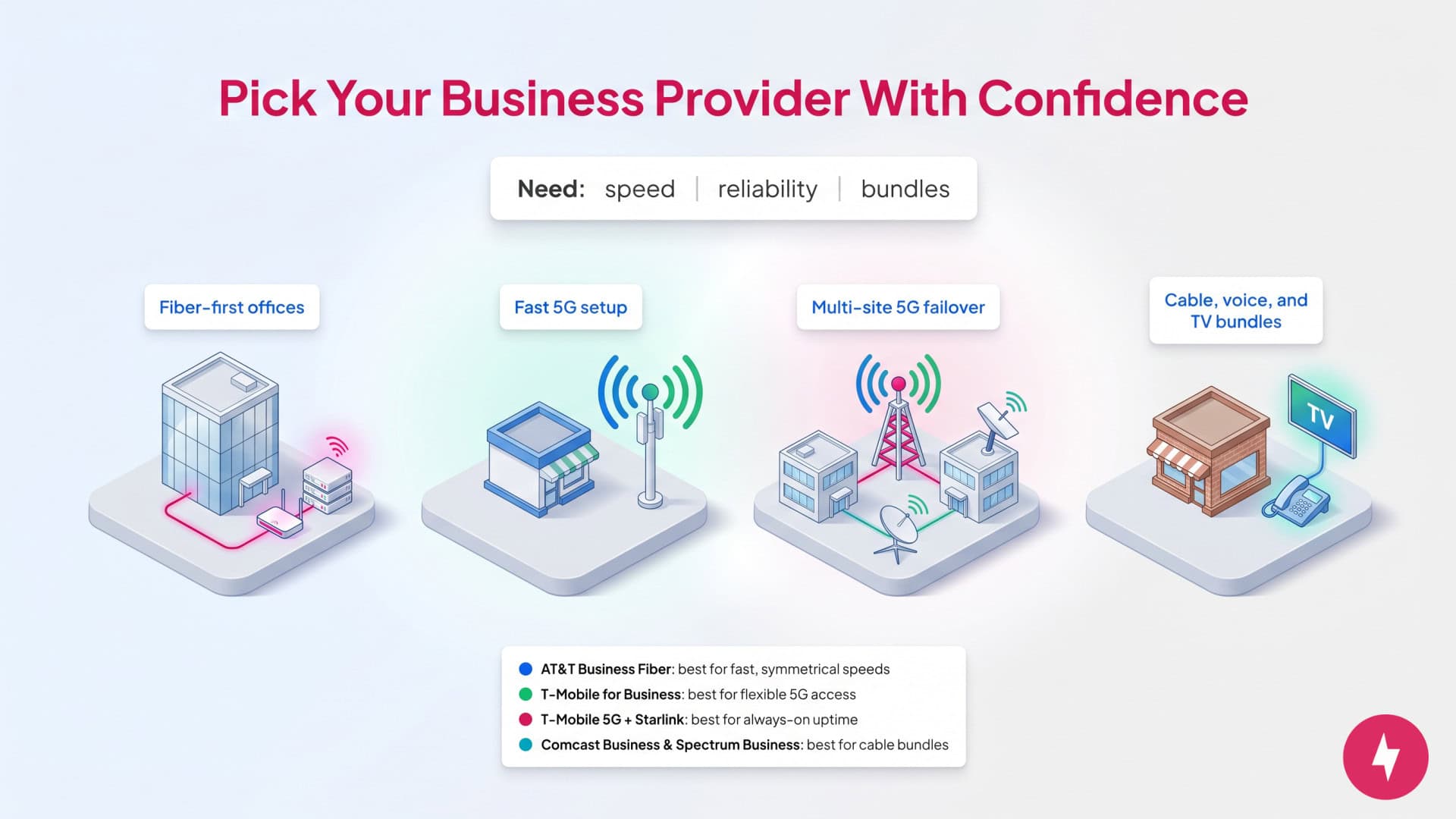
The right business internet provider should support your daily workflow without inflating your overhead or leaving your team vulnerable to outages. Start by checking if fiber is wired to your building, as AT&T Business Fiber delivers the best all-around value for offices that rely on fast, symmetrical upload and download speeds. If fiber isn’t available at your address, you want to get a new storefront online in minutes with 5G for small business, or you need unbreakable 5G and Starlink failover across multiple sites, T-Mobile for Business is the clear standout. And for brick-and-mortar businesses looking to bundle wireline cable with voice or public-view TV, Comcast Business and Spectrum Business remain dependable choices.
Frequently Asked Questions About Business Internet Providers
What is the difference between residential internet and business internet?
Business internet has additional perks that greatly benefit both small businesses and large corporations. While both types of internet offer similar speeds, business internet providers usually offer dedicated connections, providing businesses with a reliable, fast connection, especially during peak traffic hours. Additionally, business internet providers will sometimes include an internet backup option that lets businesses continue running during a power outage, along with 24/7 business-class customer service.
What is the best business internet for 100+ employees vs. small businesses?
Enterprises with 100+ employees or multiple locations are best served by AT&T Business Fiber (for symmetrical speeds up to 5 Gbps) or T-Mobile SuperBroadband (for single-contract 5G and Starlink connectivity across distributed sites). Small businesses typically get the best value from AT&T Business Fiber 300 ($60 per month) or T-Mobile Unlimited Business Internet ($35 per month with a voice line), both of which avoid annual contracts and heavy IT setup.
How much speed does a business need?
The amount of speed a business needs depends entirely on its headcount and daily software applications. A small office of up to five employees that uses basic cloud software and email can comfortably operate at speeds between 100 Mbps and 300 Mbps. Companies with more than 20 employees, regular large file transfers, complex point-of-sale systems, or heavy video conferencing demands should aim for gigabit connections offering 1 Gbps or higher. Fiber networks often provide symmetrical speeds, meaning your upload speeds match your download speeds, which is vital for quick cloud storage backups and uninterrupted video conference presentations.
Can I get business internet at home?
Yes, residents can purchase a business internet plan for their residential households. Remote workers or independent contractors can benefit most from commercial-grade stability. Note that commercial service is more costly than standard residential options and comes with enterprise-level add-ons that basic home users do not need.
Why is business internet more expensive than residential internet?
Because of additional features like automatic LTE backups, guaranteed service repair times, and prioritized bandwidth management during peak traffic hours, a business plan carries a higher monthly price tag. Commercial connections also provide higher-grade hardware, specialized IP configurations, and strict legal compliance security measures that cost the provider more to maintain.
Can small businesses get the same speeds as large enterprises?
Yes, but the cost and physical infrastructure will vary. Many major providers offer scalable plans, allowing small local shops to start with lower speeds and easily upgrade their tiers as their software demands grow. Larger enterprise operations may negotiate custom fiber build-outs with substantially faster multi-gigabit speeds and heavily reinforced SLAs.
Can business internet improve my cybersecurity?
Many business ISPs offer enhanced security features such as firewalls, malware protection, and DDoS mitigation. These services help safeguard your company’s sensitive client data and reduce financial downtime caused by modern cyberattacks.
Is 5G business internet reliable enough?
Yes, modern 5G business internet is reliable enough to serve as the primary connection for most small and midsize businesses. Standard plans from providers like T-Mobile for Business use Wi-Fi 7 gateways on nationwide 5G networks to easily handle POS systems, cloud software, and video calls. For businesses that require near-zero downtime, T-Mobile’s SuperBroadband pairs 5G Advanced with Starlink satellite backup and load balancing so your connection stays live even during a local cellular outage.
What is the best backup internet for a business?
T-Mobile for Business offers the best backup internet for business. If you want primary and backup connectivity consolidated on one bill, T-Mobile SuperBroadband ($250 per month) integrates 5G Advanced with automatic Starlink satellite failover and 24/7 monitoring in every U.S. ZIP code. If you already have fiber or cable internet and just want a low-cost wireless backup line, T-Mobile’s standard 5G plan starts at $35 per month with a voice line ($60 per month standalone).