Fixed Wireless Internet in the USA
Providers Offering Fixed Wireless Service
We've found 1746 providers offering Fixed Wireless service in the US. Below are stats on their coverage and speeds.
Terrestrial Fixed Wireless Internet In the United States
For a full list of providers offering fixed wireless internet service, visit the fixed wireless provider page where we list every provider in the US and the communities they serve.
Fixed Wireless Performance
As with all types of broadband services, speeds and plans of fixed wireless service vary from provider to provider.
In general, residential fixed wireless plans are comparable to DSL or cable in terms of speeds offered — in the neighborhood of 5–50 Mbps.
Business-class fixed wireless plans are often much faster, with leading companies offering 500 Mbps symmetrical plans that rival dedicated fiber in terms of reliability, security, and speed of installation.
While these speeds aren’t astounding they can be an incredibly appealing option, especially as an alternative to satellite service. Fixed Wireless is often available in areas with a low concentration of wired options due to the flexible nature of fixed wireless deployment.
Should You Get Fixed Wireless Internet Service?
For consumers who have relied on old dial-up connections, or satellite for their internet connections, the introduction of fixed wireless broadband into their area can be a game changer. If you live in a rural area and have few options for internet access, then fixed wireless can be a great choice.
Benefits
For consumers who have few other options besides satellite fixed wireless can be a great alternative.
Large Coverage Area
One of the most appealing benefits of fixed wireless broadband is its broad consumer availability.
Because service providers aren’t required to invest heavily in new cable and infrastructure, offering service to larger areas is often more cost effective.
Relatively Low Latency
One of the key benefits of fixed wireless broadband over other rural technologies is its relatively low latency making online gaming and video conferencing programs such as Skype feasible.
Limitations
Line of Sight
One of the biggest limitations of fixed wireless internet is that in most implementations the antenna at the consumer’s premises and the ground station of the provider must have a direct line of sight.
This can be problematic in different types of terrain and it also makes fixed wireless connections subject to different weather conditions.
Security Considerations
Encryption and authentication are the key considerations for network engineers implimenting fixed wireless service. While the security concerns for a wireless service are somewhat different from a wired one, the protocols for encrypting and authenticating connections are generaly equally secure between the two technology types.
Average Higher Residential Cost
Depending on your service area, residential fixed wireless is often slightly more expensive for the speed you receive. However, it’s often worth considering since fixed wireless providers tend to be smaller than “big cable” corporations and have local customer support and are usually faster to fix any outages or issues.
Rain Fade
Like any wireless service, severe storms can cause a slight reduction in download and upload speeds called “rain fade.”
What fixed wireless looks like
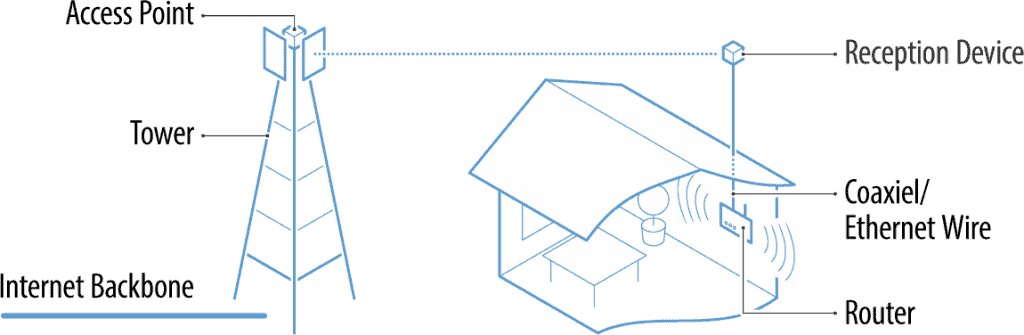
Fixed wireless broadband is a method of delivering Internet connection to consumers over the airwaves.
Similar to DSL and cable Internet, fixed wireless is a “last mile” technology that bridges the relatively short gap between the mainstream Internet “backbone” and consumer residences.

 BROADBANDNOW
While DSL and cable bridge this gap using wired phone and television connections, fixed wireless accomplishes the same outcome by broadcasting the connection via radio waves from an access point (usually mounted on a tower) to reception dishes at consumer residences.
 BROADBANDNOW
Misconceptions about fixed wireless

Fixed wireless is not satellite
While fixed wireless broadcasts from terrestrial towers, satellite Internet broadcasts from earth orbit. Satellite’s “bird’s eye view” translates to wide coverage, but the extra distance creates higher latency.
Fixed wireless is not mobile
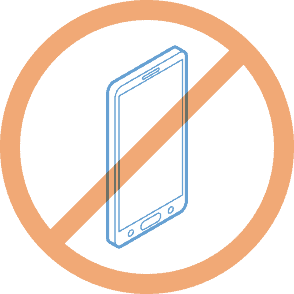
Mobile coverage operates like a giant Wi-Fi bubble — coverage is broadcast from towers, and any device within range can connect. Fixed wireless operates more like an invisible wire connecting two locations — coverage is broadcast from towers in a straight line to a specific customer.
Fixed wireless is not Wi-Fi
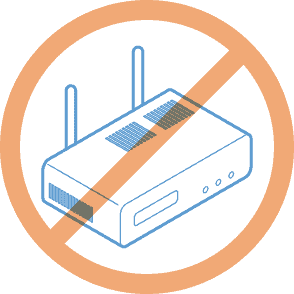
Fixed wireless provides a direct point-to-point connection, requiring line-of-sight between the access point and reception device. Unlike Wi-Fi, fixed wireless cannot pass through or around minor barriers.
Why is it called "fixed"?
 BROADBANDNOW
When implemented properly, fixed wireless can deliver gigabit connection speeds rivaling fiber connections.
Magic? Hardly. The technology that makes fixed wireless effective is surprisingly simple: directional broadcasting.
The Technology: How it works
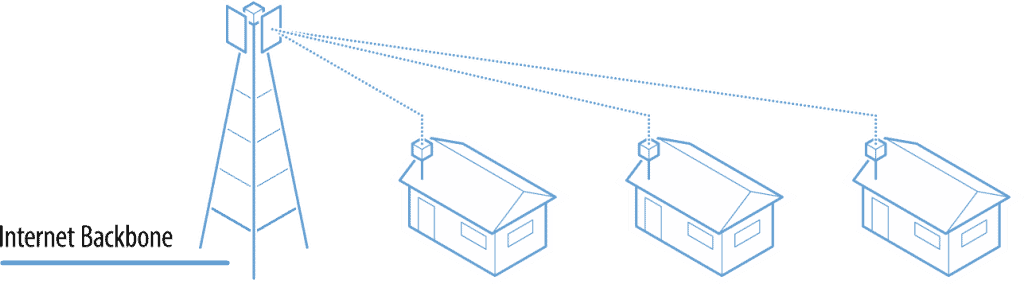
Because customer locations are stationary, fixed wireless connections can be focussed — think of how a magnifying glass channels light — making the “beam” much stronger than an omnidirectional broadcast such as AM/FM radio.
 BROADBANDNOW
Directional connections on the lower end of the radio spectrum can rival DSL and cable. Broadcasting over higher-frequency microwave and EHF (Extremely high frequency) bands boosts the signal strength even more, achieving gigabit speeds comparable to fiber when properly implemented.
It’s not just small-time Internet providers that are excited about fixed wireless. Access to EHF frequencies has led big companies like Google and Facebook to invest in developing their own fixed wireless technologies and networks.
Ambitious startups like Starry Internet plan to actively compete with major ISPs using fixed wireless technology.
The Configuration: Connection types
- Point-to-point: Point-to-point fixed wireless configurations connect two locations exclusively, like a bridge. Most often used for the connection between access points on a tower and the Internet “backbone,” or to connect two buildings that need to share their network.
- Point-to-multipoint: Point-to-multipoint fixed wireless configurations connect a set number of locations from a single access point. Most often used to bridge the gap between a tower and customer residences.
 BROADBANDNOW
The Challenge: Spectrum shortage
 BROADBANDNOW
Like any wireless technology, fixed wireless is deployed over airwaves. This creates challenges because it has to share those airwaves with every other wireless technology.
Between radio, Wi-Fi, military communications, mobile data, talk & text, satellite broadcasts, baby monitors, microwaves, ham radios, and hundreds of other devices, spectrum is crowded — so much so that most frequencies require licenses to use.
Fixed wireless technology can broadcast data across most of the radio and microwave spectrums , so the frequency of a connection varies from implementation to implementation based on what is available.
 BROADBANDNOW
Many WISPs (wireless internet service providers) in rural areas broadcast on unlicensed bands (think of them as “cowboy bands”), at the risk of interference from other devices. In urban areas signal congestion from competing broadcasts (3G, 4G, etc.) makes free bandwidth difficult to find. It is only recently that technological advances have circumnavigated this problem by opening up high frequency microwave bands.
If the FCC and private companies are able to coordinate themselves to share the spectrum, fixed wireless will likely become a major challenger to wired technologies like fiber, cable, and DSL. ,
Pros & Cons
pros
- Fast and affordable to install
- Flexible for rural coverage
- Low latency
- Generates competition for ISPs
cons
- Line-of-sight requirement
- Higher average cost
- Spectrum shortage
- Wireless security concerns
Largest Fixed Wireless Providers
-
T-Mobile 5G Home Internet
59.60% Coverage
-
XNET WiFi
51.28% Coverage
-
Mint Mobile
48.42% Coverage
-
Verizon Business
41.52% Coverage
-
AT&T Internet Air
39.02% Coverage
-
Verizon 5G Home Internet
32.22% Coverage
-
UScellular
7.02% Coverage
Fixed Wireless Providers: Availability by State
| Alabama | 4,897,165 | 97.5% | 19 Fixed Wireless Providers |
| Alaska | 378,283 | 51.6% | 11 Fixed Wireless Providers |
| Arizona | 7,002,751 | 97.9% | 50 Fixed Wireless Providers |
| Arkansas | 2,952,197 | 98.0% | 33 Fixed Wireless Providers |
| California | 38,921,427 | 98.4% | 98 Fixed Wireless Providers |
| Colorado | 5,685,376 | 98.5% | 61 Fixed Wireless Providers |
| Connecticut | 3,546,807 | 98.4% | 5 Fixed Wireless Providers |
| Delaware | 975,000 | 98.5% | 8 Fixed Wireless Providers |
| District of Columbia | 664,032 | 96.3% | 9 Fixed Wireless Providers |
| Florida | 21,204,345 | 98.5% | 25 Fixed Wireless Providers |
| Georgia | 10,476,246 | 97.8% | 18 Fixed Wireless Providers |
| Hawaii | 1,365,190 | 93.8% | 6 Fixed Wireless Providers |
| Idaho | 1,814,094 | 98.6% | 42 Fixed Wireless Providers |
| Illinois | 12,615,195 | 98.5% | 62 Fixed Wireless Providers |
| Indiana | 6,685,102 | 98.5% | 56 Fixed Wireless Providers |
| Iowa | 3,143,152 | 98.5% | 61 Fixed Wireless Providers |
| Kansas | 2,872,071 | 97.8% | 47 Fixed Wireless Providers |
| Kentucky | 4,388,684 | 97.4% | 23 Fixed Wireless Providers |
| Louisiana | 4,555,286 | 97.8% | 27 Fixed Wireless Providers |
| Maine | 1,345,330 | 98.8% | 11 Fixed Wireless Providers |
| Maryland | 6,079,624 | 98.4% | 20 Fixed Wireless Providers |
| Massachusetts | 6,869,635 | 97.7% | 12 Fixed Wireless Providers |
| Michigan | 9,895,939 | 98.2% | 42 Fixed Wireless Providers |
| Minnesota | 5,627,174 | 98.6% | 48 Fixed Wireless Providers |
| Mississippi | 2,877,475 | 97.2% | 15 Fixed Wireless Providers |
| Missouri | 6,042,278 | 98.2% | 64 Fixed Wireless Providers |
| Montana | 1,038,254 | 95.8% | 33 Fixed Wireless Providers |
| Nebraska | 1,932,670 | 98.5% | 38 Fixed Wireless Providers |
| Nevada | 3,075,431 | 99.1% | 28 Fixed Wireless Providers |
| New Hampshire | 1,352,733 | 98.2% | 9 Fixed Wireless Providers |
| New Jersey | 9,150,588 | 98.5% | 7 Fixed Wireless Providers |
| New Mexico | 2,041,503 | 96.4% | 42 Fixed Wireless Providers |
| New York | 19,823,486 | 98.1% | 17 Fixed Wireless Providers |
| North Carolina | 10,231,644 | 98.0% | 24 Fixed Wireless Providers |
| North Dakota | 706,093 | 90.6% | 13 Fixed Wireless Providers |
| Ohio | 11,646,055 | 98.7% | 52 Fixed Wireless Providers |
| Oklahoma | 3,871,059 | 97.8% | 46 Fixed Wireless Providers |
| Oregon | 4,169,036 | 98.4% | 46 Fixed Wireless Providers |
| Pennsylvania | 12,769,952 | 98.2% | 33 Fixed Wireless Providers |
| Rhode Island | 1,067,640 | 97.3% | 5 Fixed Wireless Providers |
| South Carolina | 5,031,924 | 98.3% | 11 Fixed Wireless Providers |
| South Dakota | 832,758 | 93.9% | 22 Fixed Wireless Providers |
| Tennessee | 6,778,152 | 98.1% | 20 Fixed Wireless Providers |
| Texas | 28,670,433 | 98.4% | 125 Fixed Wireless Providers |
| Utah | 3,231,375 | 98.8% | 35 Fixed Wireless Providers |
| Vermont | 626,357 | 97.4% | 13 Fixed Wireless Providers |
| Virginia | 8,406,114 | 97.4% | 28 Fixed Wireless Providers |
| Washington | 7,577,373 | 98.3% | 47 Fixed Wireless Providers |
| West Virginia | 1,727,707 | 96.3% | 28 Fixed Wireless Providers |
| Wisconsin | 5,801,776 | 98.4% | 37 Fixed Wireless Providers |
| Wyoming | 561,103 | 97.3% | 26 Fixed Wireless Providers |

Written by
Are you a journalist or researcher writing about this topic?
Contact us and we'll connect you with a broadband market expert on our team who can provide insights and data to support your work.