Does Starlink Offer Low-Income Internet or Discounts?

- Starlink does not participate in the federal Lifeline program or offer dedicated income-based assistance tiers.
- Subscribers can avoid the $349 standard upfront hardware purchase by renting equipment or buying used kits.
- Starlink periodically introduces localized rate drops by up to 50% in lower-demand geographic zones to attract new users.
For millions of Americans living in rural and off-grid communities, Starlink has revolutionized access to high-speed internet. Using a massive constellation of low-Earth orbit (LEO) satellites, SpaceX’s satellite internet service delivers download speeds and latency that traditional geostationary providers like Hughesnet and Viasat simply cannot match. But high performance comes at a steep price.
Between monthly service fees and hundreds of dollars in upfront equipment costs, the service remains out of reach for many budget-conscious households. This leads many consumers to wonder: Does Starlink offer low-income internet? If you are looking for Starlink low-income internet, subsidized rates, or general Starlink discounts, navigating the company’s pricing structure can be confusing. Here’s a comprehensive breakdown of whether Starlink accepts Lifeline, how to lower your equipment and monthly costs, and where to find affordable alternatives to Starlink
Quick Answer: Starlink Low-Income Options: Starlink doesn’t currently participate in Lifeline or offer low-income discounts, senior plans, or student pricing for its residential service. Budget-conscious consumers can lower startup costs by renting equipment, shopping for used dishes, or taking advantage of regional plan discounts in select markets.
Does Starlink Offer Low-Income Internet?

The direct answer is no: Starlink does not currently participate in Lifeline or any federal low-income broadband subsidy programs.
While many traditional wired (fiber, cable, DSL) and wireless internet service providers (ISPs) participate in state and federal assistance initiatives, SpaceX has chosen not to enroll Starlink in federal benefit programs for residential users in the United States.
Does Starlink Accept Lifeline?
No, Starlink doesn’t currently participate in Lifeline. Lifeline is a long-standing Federal Communications Commission (FCC) program that provides a $9.25 monthly discount (or up to $34.25 on qualifying Tribal lands) for low-income households.
Starlink Senior Discount and Student Discount Availability
If you are searching for a Starlink senior discount or a Starlink student discount, you will not find official standing programs on Starlink’s site.
- No senior discounts: Starlink applies uniform flat-rate pricing regardless of age or retirement status.
- No student discounts: Unlike some wired ISPs, Starlink does not offer reduced monthly fees or waived hardware fees for enrolled university or K-12 students.
Despite the absence of traditional subsidized tiers, there are several strategic ways to reduce Starlink costs.
Ways to Lower the Cost of Starlink

While a dedicated Starlink assistance program doesn’t exist, SpaceX has introduced flexible hardware purchasing options and regional tier adjustments to make the service more accessible. Here’s a comparison of Starlink hardware costs to consider.
| Hardware option | Upfront cost | Monthly fee |
|---|---|---|
| New standard kit | $349 | $0 |
| Used standard kit | $250–$299 | $0 |
| Starlink Mini kit | $199–$349 | $0 |
| Equipment rental | $0 | $0–$10 |
1. Rent or Purchase Starlink Equipment
Historically, the single largest barrier to getting Starlink was the steep $499 upfront hardware cost. The company has lowered the upfront cost, though it is still a bit pricey for the budget-conscious shopper at $349. Subscribers can choose to rent or purchase Starlink equipment depending on their budget:
- Equipment rentals: In select service areas, Starlink allows residential customers to rent the dish and router kit for a monthly fee (typically around $10/month) with $0 upfront hardware costs. This option eliminates the initial investment, making startup significantly cheaper. Some areas may qualify for a free monthly rental, but eligibility depends heavily on location and current promotions.
- Outright purchase: Buying the equipment outright currently costs around $349 for the Standard Gen 3 Kit, down from previous years.
2. Used Starlink Dishes
If you prefer ownership over renting but want to avoid retail hardware costs, consider used Starlink dishes:
- Third-party used hardware: You can buy used Starlink dishes on secondary marketplaces like eBay or Craigslist. However, the seller must officially transfer the hardware registration from their Starlink account to yours before activation. Never purchase a used dish without verifying that the seller has canceled their active service and released the terminal ID.
3. Starlink Regional Discounts and Promotions
Depending on network capacity and regional demand, SpaceX frequently tests targeted Starlink regional discounts and promotions:
- Regional service price tiers: In markets with excess network capacity, Starlink has lowered monthly residential service fees from the standard rate, sometimes by up to 50 percent. Conversely, high-demand, congested regions may face higher rates or excess-demand fees.
- Hardware promos: Regional retail partners (such as Home Depot or Best Buy) occasionally run local sales on hardware kits, offering temporary discounts off the retail price.
Current Starlink Plans and Pricing

To help you calculate total costs, here is how standard residential and roam plans compare. You can choose lower-tiered plans if you have low bandwidth needs to save money on your monthly internet plan. Compared to other providers, Starlink’s pricing is comparable, and the provider’s service outpaces other satellite internet providers.
| Plan | Price (per month) | Download speeds (up to) | Hardware cost | Best for |
|---|---|---|---|---|
| Residential 100 Mbps | $55 | 100 Mbps | $349 or $0–$10 monthly rental | Budget-conscious rural homes with light bandwidth needs |
| Residential 200 Mbps | $85 | 200 Mbps | $349 or $0–$10 monthly rental | Typical rural households needing unlimited high-speed data |
| Residential MAX | $130 | 400 Mbps | $349 or $0–$10 monthly rental | Heavy streaming, online gaming, and multi-user households |
| Roam 100 GB | $55 | 300 Mbps | $199–$349 | Travelers with low bandwidth or select internet needs |
| Roam 300 GB | $80 | 300 Mbps | $199–$349 | RVers, campers, or travelers with moderate bandwidth needs |
| Roam Unlimited | $175 | 300 Mbps | $199–$349 | Digital nomads with high bandwidth needs |
Affordable Alternatives to Starlink
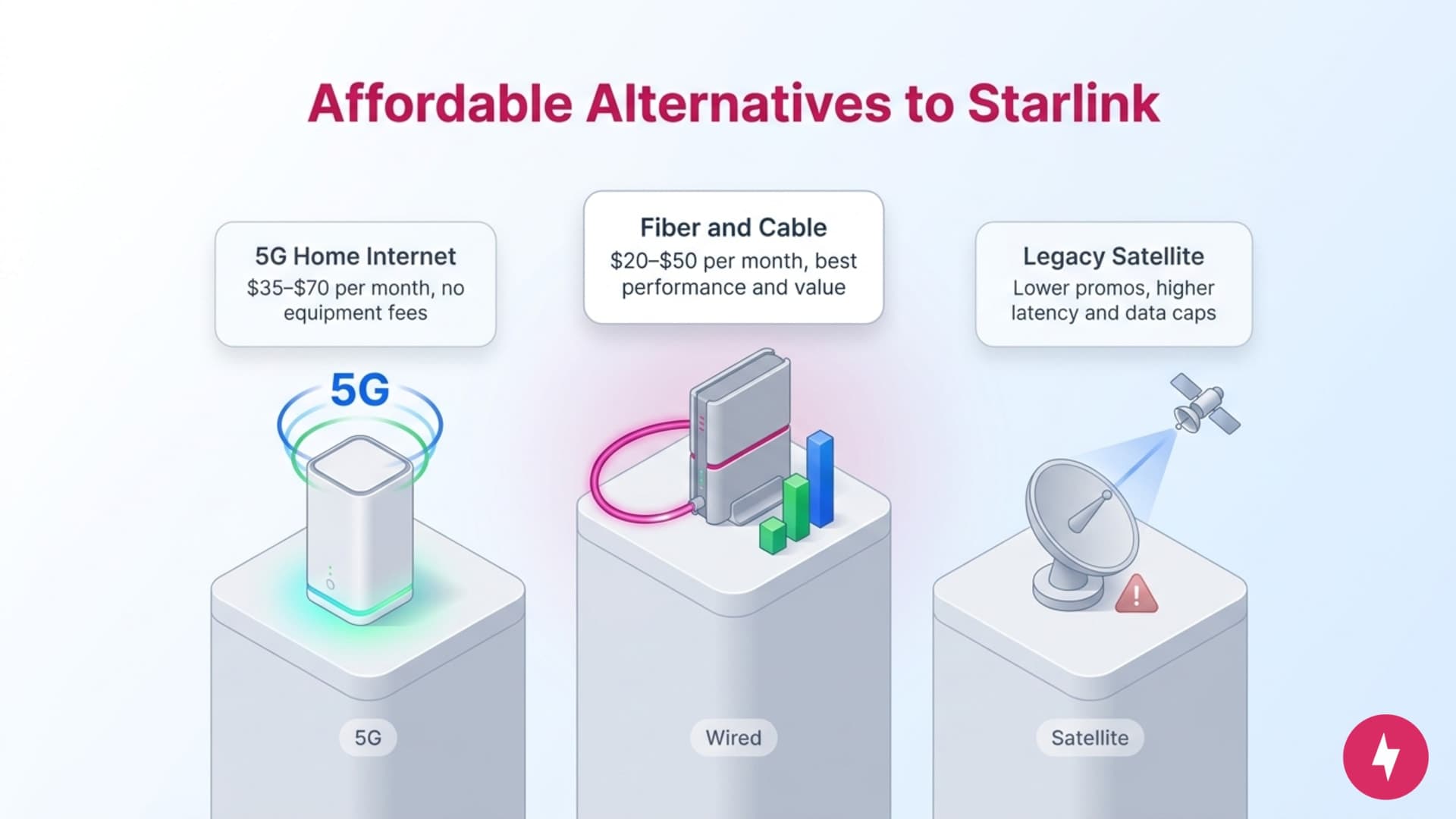
If Starlink’s standard pricing remains too high for your household budget, several lower-cost internet options may be available in your area. While satellite coverage is universal, alternative technologies often deliver significantly better value if you fall within their coverage footprints.
| Internet type | Average monthly cost | Download speed (range) |
|---|---|---|
| Fiber | $30–$300 | 200 Mbps to 20 Gbps |
| Cable | $20–$120 | 10 Mbps to 2 Gbps |
| DSL | $40–$50 | 5 to 120 Mbps |
| 5G Home Internet | $35–$70 | 72 Mbps to 1 Gbps |
| Starlink (LEO satellites) | $55–$130 | 100 to 400 Mbps |
| Viasat and Hughesnet (GEO satellite internet) | $40–$120 | 25 to 150 Mbps |
1. 5G Home Internet (T-Mobile & Verizon)
Fixed wireless 5G home internet has expanded rapidly into rural and suburban communities, making it a competitive option against satellite internet.
- Cost: $35 to $70 per month with no upfront equipment fees.
- Lifeline eligibility: Many mobile network operators offer subsidized or low-income tiers on their network lines.
- Verdict: If available, 5G home internet is usually much cheaper than Starlink and requires zero hardware purchase.
2. Wired Internet (Fiber & Cable)
Wired connections like fiber or cable remain the gold standard for internet performance and value. However, availability in rural areas is limited, which is why wireless options are preferred there.
- Cost: Entry-level tiers start at $20–$50 per month.
- Low-income programs: Almost all major cable and fiber providers (such as Xfinity, Spectrum, AT&T, and Cox) offer dedicated low-income tiers for $10 to $30 per month, alongside participation in Lifeline.
- Verdict: Always check for wired options before committing to satellite service.
3. Legacy Satellite Internet (Hughesnet & Viasat)
If satellite is your only option, traditional geostationary providers are an alternative, though they come with speed and latency trade-offs.
- Cost: Promotional rates often start lower than Starlink (around $50/month), but pricing quickly escalates after promotional periods end.
- Lifeline eligibility: Viasat participates in the Lifeline program, but Hughesnet does not.
- Verdict: Legacy satellite exhibits much higher latency (600+ ms) and strict data caps, making it less desirable than Starlink for interactive uses like Zoom calls or online gaming.
LEO vs. GEO Satellites: What’s the Difference? Low-Earth Orbit (LEO) satellites orbit Earth at much lower altitudes (around 300 to 1,200 miles), delivering significantly higher speeds and lower latency than Geostationary Orbit (GEO) satellites, which orbit at about 22,000 miles above Earth. Because LEO satellites are closer, signals travel a shorter distance, making real-time activities like video calls and online gaming far smoother than on traditional GEO networks.
Is Starlink Worth It for Low-Income Households?
For households seeking cheap Starlink internet, options are limited. Because Starlink doesn’t currently participate in Lifeline or offer dedicated financial assistance tiers, it remains one of the more expensive consumer broadband solutions on the market.
However, if you live off the grid or in a rural dead zone without access to cable, fiber, or 5G home internet, you can reduce your startup expenses by opting to rent or purchase Starlink equipment, seeking out used Starlink dishes, or checking for local Starlink regional discounts and promotions.
Before investing hundreds of dollars in satellite hardware, make sure you have explored all wireline and wireless providers in your specific ZIP code.
Frequently Asked Questions About Starlink Discounts
Does Starlink offer a 30-day trial or money-back guarantee?
Yes, Starlink offers a 30-day trial period. If you are unsatisfied with the service performance within 30 days of receiving your equipment, you can cancel your subscription and return the hardware kit for a full refund of the equipment cost. Note that shipping fees and the first month’s service charge are generally non-refundable.
Can I transfer a used Starlink dish to another owner to save money?
Yes, but the transfer process must be initiated by the original owner. The existing owner must cancel active service and click “Transfer” in their Starlink account dashboard to release the Kit Serial Number. Once released, the buyer can set up a new account and register the hardware at Starlink’s activation page.
Does Starlink charge extra fees for equipment rentals or activation?
If you opt for Starlink’s equipment rental option, you will pay a monthly rental fee (typically $10/month) rather than buying the hardware upfront. Depending on your region, Starlink may charge a standard shipping and handling fee, but there are no mandatory long-term service contracts or early termination fees.
Are there any hidden fees or data overage charges on Starlink?
Starlink residential plans feature unlimited data with no hard data caps or overage charges. However, in heavily congested areas during peak network hours, Standard subscribers may experience temporary speed deprioritization behind Priority or High-Demand plan tiers.
Why doesn’t Starlink participate in the federal Lifeline program?
To participate in Lifeline, service providers must be designated as Eligible Telecommunications Carriers (ETCs) by state regulatory commissions and adhere to specific compliance, pricing, and administrative standards set by the FCC. SpaceX has chosen not to maintain ETC status for residential broadband accounts across US states, focusing instead on uniform direct-to-consumer pricing.
Can I pause my Starlink Residential plan if I can’t pay for a month?
No, you cannot pause a standard Starlink Residential plan to hold your service address without payment. If you cancel your Residential plan, your address slot may be given to someone on a waitlist if your area is at capacity. However, Starlink Roam plans allow users to pause and unpause service at will without losing account status.